








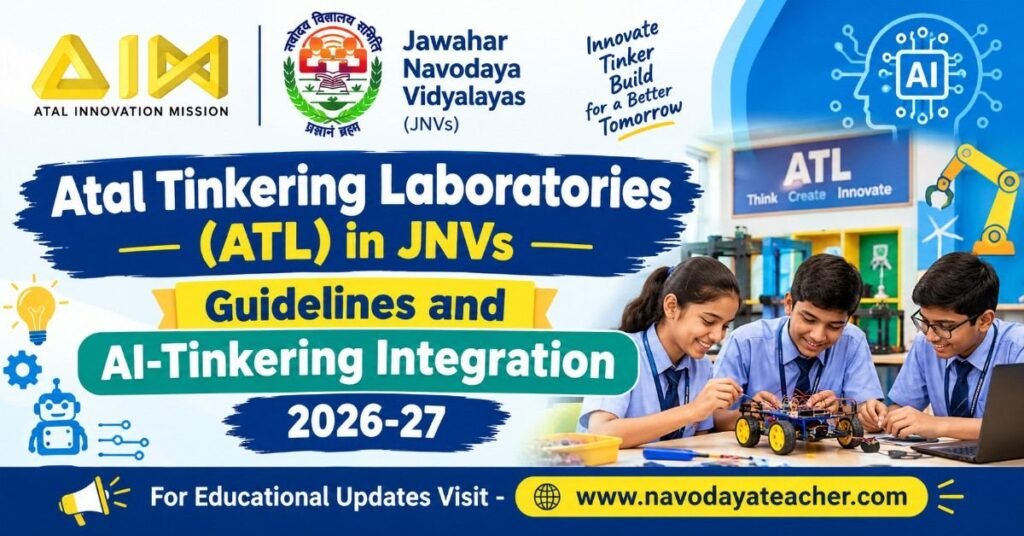
In this article we providing information regarding latest Atal Tinkering Labs in JNVs: Guidelines 2026-27.
Atal Tinkering Labs in JNVs: Guidelines 2026-27
Atal Tinkering Laboratories (ATL) are dedicated innovation and experimentation spaces established to encourage creativity, scientific temperament, curiosity and problem-solving skills among school students. Under the Atal Innovation Mission (AIM), NITI Aayog, ATL facilities provide students with opportunities to explore emerging technologies and develop innovative ideas beyond traditional textbook learning.
As per the Perspective Academic Plan 2026-27, Atal Tinkering Laboratories have been established in 134 Jawahar Navodaya Vidyalayas (JNVs), while ATLs are being established in the remaining JNVs under the PM SHRI initiative.
What are Atal Tinkering Laboratories?
Atal Tinkering Laboratories are dedicated workspaces where students from Classes VI to XII can learn innovation skills, experiment with technologies and develop ideas that can address real-world problems.
ATL facilities expose students to modern tools and technologies such as:
- 3D Printers
- Robotics
- Electronics Development Tools
- IoT Devices and Sensors
- Design and Computational Thinking Tools
- Artificial Intelligence
- Data Visualisation
- Prototyping and Model Development
The objective is not merely to teach technology but to develop curiosity, creativity, innovation, critical thinking and problem-solving abilities among students.
ATL activities also encourage students to move beyond conventional classroom and textbook learning towards learning by doing.
AI and Tinkering Across the Curriculum
Artificial Intelligence (AI) and Tinkering can be effectively integrated with different school subjects. Although AI and Tinkering follow a practical and innovative approach, they have strong connections with concepts already taught through the school curriculum.
The process involves identifying a problem, asking questions, proposing a hypothesis, experimenting with different possibilities and finally developing a model, solution or prototype.
For example, students can connect their tinkering projects with:
- Science: Scientific principles, experiments and applications
- Mathematics: Measurement, calculations, patterns and data
- Social Science: Real-life social problems and community needs
- Languages: Reading, writing, speaking and presentation
- Computer Science: Programming, AI, IoT and computational thinking
Therefore, AI and Tinkering can become an effective way of developing both knowledge and practical skills.
Important Skills Developed Through AI and Tinkering
1. Questioning Skills
Questioning is the starting point of an AI or Tinkering project. Students identify a problem and ask questions about how it can be solved.
This develops:
- Curiosity
- Logical thinking
- Problem identification
- Interest in experimentation
- Scientific thinking
Encouraging students to ask meaningful questions can help create a strong foundation for innovation.
2. Reflection
Reflection is an important part of the AI and Tinkering process.
Students observe their work, analyse results, identify mistakes and think about how their solution can be improved. This helps them understand the practical application of curricular concepts and better understand the world around them.
3. Learning by Doing
ATL activities strongly support the Learning by Doing approach.
Instead of learning concepts only through books or lectures, students get opportunities to:
- Build models
- Conduct experiments
- Design prototypes
- Test ideas
- Identify errors
- Improve their solutions
This makes learning more meaningful and engaging.
4. Practical Application of Concepts
AI and Tinkering allow students to apply concepts of Mathematics, Science, Engineering and Technology in practical situations.
Students can learn about:
- Working principles of devices
- Electronic components
- Materials
- Mechanical systems
- Sensors
- Construction techniques
- Data
- Programming
- Artificial Intelligence
- Internet of Things
Three-Level ATL Curriculum
The Atal Innovation Mission has developed a Three-Level Curriculum for Atal Tinkering Laboratories. The curriculum provides a structured learning pathway for students to develop and improve their innovation skills.
The curriculum covers areas such as:
- Basic Electronics
- Electronics
- Mechanics
- Data Visualisation
- Design Thinking
- 3D Design and Printing
- Artificial Intelligence
- Internet of Things (IoT)
- Woodworking
- Design and Entrepreneurial Thinking
Level 1
Level 1 consists of 5 modules:
- Basic Electronics
- Mechanics
- 3D Design & Printing
- Data Visualization
- Design & Entrepreneurial Thinking
These modules are divided into 14 sessions.
Level 2
Level 2 consists of 4 modules:
- Electronics
- Mechanics
- 3D Design & Printing
- Design & Entrepreneurial Thinking
These modules are divided into 13 sessions.
Level 3
Level 3 consists of 5 modules:
- Electronics
- Internet of Things (IoT)
- 3D Design & Printing
- Woodworking
- Design & Entrepreneurial Thinking
These modules are divided into 17 sessions.
Students should complete one level before moving to the next level.
ATL Implementation Guidelines for JNVs
The Perspective Academic Plan 2026-27 provides specific guidelines for the effective utilisation of ATL facilities in JNVs.
ATL for Classes VI to IX
JNVs having functional ATLs should integrate one ATL period per week into the timetable for Classes VI to IX.
The ATL course should begin with Level 1 and progress to Level 3. Students should complete each level before moving to the next level.
Distribution of ATL Periods
For Classes VI to IX, ATL periods should be distributed among:
- TGT Science
- TGT Mathematics
- TGT Computer Science
One class may be allotted to one teacher, and one regular period of the concerned teacher may be earmarked for ATL activities.
ATL for Classes X to XII
For senior classes, AI and Tinkering should be integrated with classroom lessons and practical activities.
Class X
AI and Tinkering integrated lesson plans and experiments should be implemented for all students of Class X.
Classes XI and XII
AI and Tinkering activities should be implemented for students of the Science Stream.
Frequency of ATL Sessions
At least one ATL session every fortnight should be allotted to each class from Classes X to XII.
ATL periods for these classes may be allotted to:
- PGT Physics
- PGT Chemistry
- PGT Computer Science
- PGT Biology
One regular period of the concerned teacher may be earmarked for ATL activities.
Common Guidelines for All JNV Classes
The following guidelines are important for effective implementation of ATL activities in JNVs.
1. Monthly ATL Activity Update
Every school must update its monthly ATL activities and submit the details through the MyATL Dashboard.
MyATL Dashboard: https://atl.aim.gov.in/
2. Distribution of ATL Periods
The Principal should plan the timetable in such a way that ATL periods are distributed throughout the week.
3. Exposure for Every Student
AI and Tinkering integrated lesson plans should be implemented with all students so that every student gets an opportunity to understand innovation and emerging technologies.
4. Participation of Science and Mathematics Teachers
All Science and Mathematics teachers in JNVs should be involved in ATL activities.
5. Three-Level Learning
All students should get an opportunity to go through the three levels of the ATL curriculum.
Students who demonstrate greater interest in experimentation and innovation can be encouraged to move towards advanced project development and prototyping.
6. Extra Time for Interested Students
Students who are particularly interested in AI and Tinkering should be provided additional time in the ATL to:
- Develop real-time projects
- Experiment with ideas
- Build prototypes
- Test solutions
- Improve existing models
7. Integration with School Activities
JNVs should make ATL activities part of regular academic and co-curricular activities.
ATL resources can be integrated with:
- Regular Science classes
- Mathematics classes
- Computer Science activities
- Science Clubs
- Innovation activities
- Project-based learning
Schools can also utilise available resources from the Science Laboratory and procure additional resources required for Tinkering activities.
Why ATL is Important for JNV Students
Atal Tinkering Laboratories provide students with an opportunity to develop skills that are increasingly important in the modern world.
Through ATL activities, students can develop:
- Creativity
- Innovation
- Critical Thinking
- Problem-Solving
- Collaboration
- Communication
- Computational Thinking
- Design Thinking
- Scientific Temper
- Digital Skills
- Entrepreneurship
- AI Awareness
Most importantly, ATL helps students understand that learning is not limited to textbooks. Students can identify real-world problems, develop ideas, experiment with solutions and create working prototypes.
Role of JNVs in Promoting Innovation
Jawahar Navodaya Vidyalayas have an important role in providing quality education and equal opportunities to students, particularly those from rural areas.
The expansion of Atal Tinkering Laboratories across JNVs under the PM SHRI initiative can provide students with access to modern technologies and innovation-oriented learning.
Schools should therefore ensure that ATL resources are used effectively, regularly and judiciously.
The focus should be on creating an environment where students are encouraged to ask questions, experiment, make mistakes, learn from them and develop innovative solutions.
Conclusion
Atal Tinkering Laboratories are an important step towards developing an innovation-oriented learning environment in Jawahar Navodaya Vidyalayas.
The ATL Three-Level Curriculum, integration of Artificial Intelligence and Tinkering, regular ATL periods, interdisciplinary projects and hands-on activities can help students develop future-ready skills.
For JNVs, effective implementation of ATL activities during the 2026-27 academic session can provide students with valuable opportunities to connect classroom concepts with real-world applications and develop the confidence to become innovators and problem-solvers.
Source: Perspective Academic Plan 2026-27, Atal Tinkering Laboratories and AI-Tinkering Integration Guidelines.
Thanks to Beloved Readers.
