











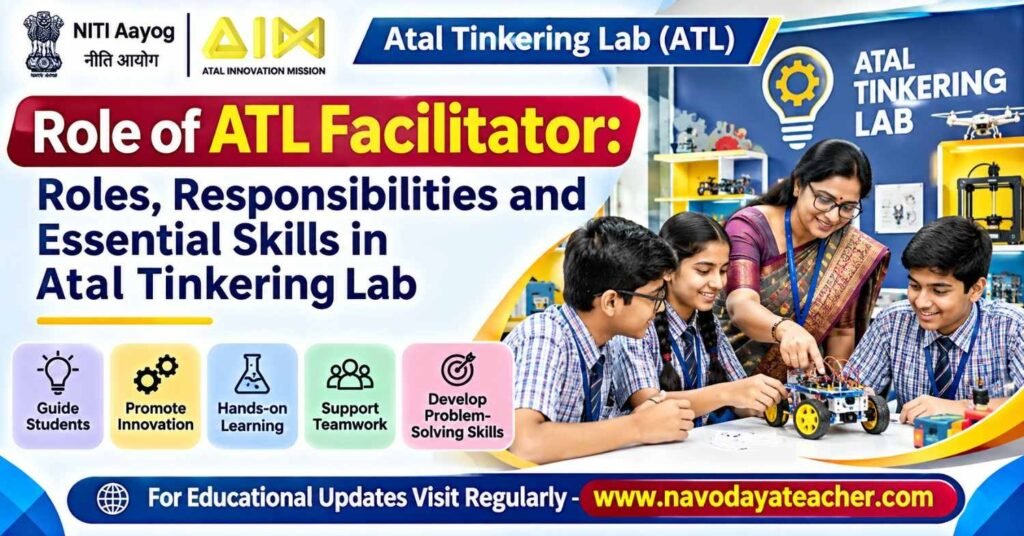
In this article we providing information regarding latest Role of ATL Facilitator: Roles and Responsibilities.
Role of ATL Facilitator: Roles, Responsibilities and Essential Skills in Atal Tinkering Lab
An ATL Facilitator (Atal Tinkering Lab Facilitator) plays an important role in promoting innovation, creativity and problem-solving skills among school students. Under the Atal Innovation Mission (AIM), NITI Aayog, ATL Facilitators guide students in exploring new technologies, conducting experiments and developing innovative solutions to real-life problems.
The main responsibility of an ATL Facilitator is to create an engaging learning environment where students can learn through practical activities, teamwork and experimentation.
Key Roles and Responsibilities of an ATL Facilitator
- 1. Guide Students: Help students understand and use ATL tools, equipment and technologies.
- 2. Encourage Creativity and Innovation: Motivate students to think differently, generate new ideas and develop innovative projects.
- 3. Promote Hands-on Learning: Organise practical activities, experiments and Do-It-Yourself (DIY) projects.
- 4. Develop Problem-Solving Skills: Encourage students to identify real-life problems and find creative solutions.
- 5. Promote Teamwork: Encourage group activities, collaboration and sharing of ideas among students.
- 6. Support Project Development: Guide students in designing, developing, testing and improving prototypes.
- 7. Ensure Inclusive Participation: Provide equal opportunities to students from different backgrounds and with different abilities.
- 8. Encourage Independent Learning: Motivate students to explore, experiment, ask questions and learn from mistakes.
- 9. Maintain ATL Equipment: Ensure the proper use, safety and maintenance of laboratory tools and equipment.
- 10. Organise Innovation Activities: Conduct ATL workshops, exhibitions, competitions, demonstrations and innovation-related programmes.
Essential Skills of an ATL Facilitator
An effective ATL Facilitator should possess the following qualities:
- Creativity and innovative thinking
- Effective communication skills
- Passion for learning new technologies
- Problem-solving abilities
- Teamwork and collaboration
- Patience and leadership
- Planning and organisational skills
- Ability to motivate and guide students
Importance of an ATL Facilitator in Schools
An ATL Facilitator acts as a mentor, guide and motivator for students. They help students move beyond classroom learning and develop practical knowledge through experimentation and innovation.
Through effective ATL activities, students develop important 21st-century skills, including creativity, critical thinking, communication, collaboration and entrepreneurship.
Conclusion
The ATL Facilitator plays a vital role in making Atal Tinkering Labs successful. Their responsibility is not just to teach students how to use laboratory equipment but also to inspire them to think creatively, explore new possibilities and develop solutions to real-world challenges.
An ATL Facilitator inspires students to Think, Explore, Create, Experiment and Innovate.
Thanks to Beloved Readers.
